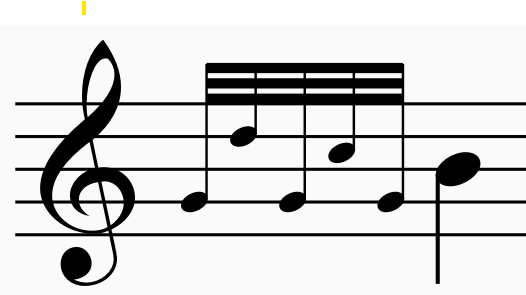
In throws to D, the low G is made longer, indicated by the first low G gracenote being a 16th note (semiquaver), rather than a 32nd note as in light music. The instructions are the same as in light music; only the rhythm is different. The canntaireachd word is 'tra'.

- From a note lower than E - dre
- From a note higher than E - edre
A throw to E consists of an E gracenote to low A, cutting the low A with an F gracenote, and then opening E. When the preceding note is lower than E then the beat happens on the first low A. If preceding note is above E then it is necessary to sound the E for a moment first, and then go to low A, cut it with an F gracenote and bounce back to E. In the situation, the beat lands on the first E, and it sounds for longer than a gracenote (it sounds like a normal note - 'e-dre').

- From a note lower than F - dare
- From a note higher than F - vedare
- From F itself - hedale
A throw on F consists of an F gracenote to E, which is then cut again by a high G gracenote before opening F. The rhythmical aproach is the same as for throws to E - when the preceding note is lower than F the beat lands on the first E, and when the preceding note is above F, it is necessary to add an preliminary F on the beat and then proceed with the the E and the cut.

- From E to high G - chedari or chehedari
A throw to High G is a bit more complicated. than the others. There are three Es to be heard; one before the beat (longish) and two after (the same as each other, and shorter than the first E). The first E, before the beat, is introduced by an F gracenote, and the the two after the beat have a High G gracenote and another F gracenote.
In piobaireachd, the only doublings you will find (apart from a variation doublings) are to High G and High A.

High G doublings come in two flavours; from low G and from low A. The pitches are E gracenote to low G (which closes on the beat) and then cut the G with an F gracenote, followed by the High G. From low A the rhythm is the same, as are the gracenotes, but instead of low G, low A appears in the middle. The low Gs and the low As are the same length as each other.


High A doublings are the same as in light music, and the canntaireachd name for this is 'dili'.
Miscellaneous other piobaireachd embellishments