Teach Yourself Bagpipes by Lindsay Davidson
bringing quality 'piping instruction to you for free| Select course Site entry page | How to practise | Highland Bagpipe library (+videos and hints) | Lindsay Davidson's tune library (scores only) | Smallpipe library | Medieval pipes library | Site map |
| Buy Lindsay's Books | ||||||
The Gordon's Salute
(videos at the bottom of the page)
The Gordon's Salute is an excellent piobaireachd for helping a non-piping audience access this style of music because the structure is exceptionally clear and lends itself to being drawn out and exposed.
Each variation will be discussed here separately, and a video with the complete music to play along with is at the end (high pitch and low pitch).
The full music, notated mostly conventionally:

Where there is a 'T' or a 'C' written under the note, this means play a high G gracenote to the note and if 'T' then you play a taorluath to low A, and if 'C' then you play a crunluath to E.
This is a very helpful convention and saves lots of ink and paper. You play the Taorluath variation first, then the crunluath.
This abbreviation also means you can see the essential harmonic and melodic structure. It is alwas good to learn piobaireachd from these variations to the beginning, noting where the Ground and last variations deviate from each other.
Canntaireachd
It is very wise to learn the canntaireachd words for each piobaireachd you study and learn how to sing the tune whilst you get the technical elements and general understanding in place.
The canntaireachd reveals that the Es which are so common here are to be thought about as cadence notes, so not main beat notes, but a kind of auxiliary note.
It is suggesed to listen to the video and sing a long with it, paying attention to where you need to breathe and where you feel you should get louder or quieter. This natural rise and fall in your singing will contribute to your sense of connection with your interpration and hep uidl greater sense into it.
Singing a hundred times before you even touch the chanter is OK!
Ground/Urlar
The actual rhythm...
The true challenge of performing piobaireachd is getting the effects that can be produced by singing and taking breaths to come across effectively with a continuous sound and gracenotes to give accents.
This leads to a tremendously complex rhythmical reality.
It is possible (but extremely complex) to notate every single finger movement and its timing in staff notation, and this can be tested and proofed by asking a computer to play the result. Doing this is an extremely helpful exercise as it reveals exactly where the irregularities are and how to comprehend them and overcome them so that the melody can be adequately presented. The full in-depth notation...is essentially impossible to usefully read as it involves rhythmical contrast ranging from whole notes to 1/1024th notes and triplets inside triplets too..
Here is a presentation of a half way house - showing the big rhythmical questions, but leaving some thigns as gracenotes for clarity.
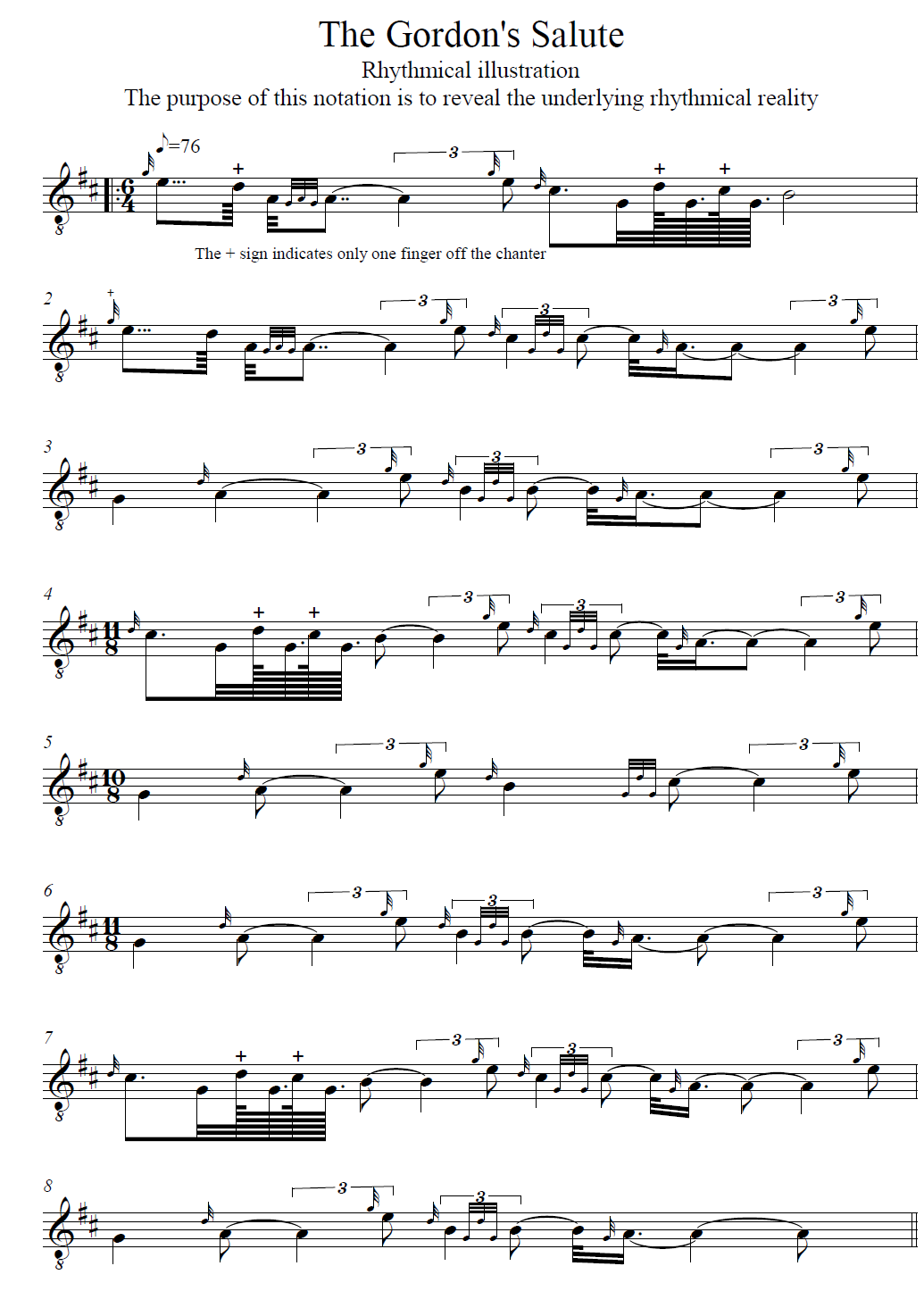 .
Discussion points about the Ground/Urlar
It isn't 4/4...
Discussion points about the Dithis
Discussion points about the Taorluath
Discussion points about the Crunluath
'Active' elements...
It is conventional to repeat the Ground for piobaireachd after you have played all the variations. For longer pieces in public performance, the piper often only repeats the first line. For small pieces like this and for private satisfaction, repeating the whole Ground is a good idea.
It is common to add a crunuath a mach variation in this tune, and especially effective for concert perfoemance.
Once you have thought about all of these things, you can sing and play along with the videos below. These videos are made from the notation and are played by the computer as a demonstration that this approach is possible and actually works.
The Gordon's Salute from midi - whole tune low pitch
The Gordon's Salute from midi - whole tune high pitch
(videos at the bottom of the page)
The Gordon's Salute is an excellent piobaireachd for helping a non-piping audience access this style of music because the structure is exceptionally clear and lends itself to being drawn out and exposed.
Each variation will be discussed here separately, and a video with the complete music to play along with is at the end (high pitch and low pitch).
The full music, notated mostly conventionally:
Where there is a 'T' or a 'C' written under the note, this means play a high G gracenote to the note and if 'T' then you play a taorluath to low A, and if 'C' then you play a crunluath to E.
This is a very helpful convention and saves lots of ink and paper. You play the Taorluath variation first, then the crunluath.
This abbreviation also means you can see the essential harmonic and melodic structure. It is alwas good to learn piobaireachd from these variations to the beginning, noting where the Ground and last variations deviate from each other.
Canntaireachd
It is very wise to learn the canntaireachd words for each piobaireachd you study and learn how to sing the tune whilst you get the technical elements and general understanding in place.
The canntaireachd reveals that the Es which are so common here are to be thought about as cadence notes, so not main beat notes, but a kind of auxiliary note.
It is suggesed to listen to the video and sing a long with it, paying attention to where you need to breathe and where you feel you should get louder or quieter. This natural rise and fall in your singing will contribute to your sense of connection with your interpration and hep uidl greater sense into it.
Singing a hundred times before you even touch the chanter is OK!
Ground/Urlar
Line 1 Hiharin hihodarodo, hiharin hihodrodin, hiemdan hihiotrodin Line 2 Hihodarodo hihodrodin, hiemdan hihiodro, hiemdan hihiotrodin Line 3 Hihodarodo hihodrodin, hiemdan hihiotrodin. |
The actual rhythm...
The true challenge of performing piobaireachd is getting the effects that can be produced by singing and taking breaths to come across effectively with a continuous sound and gracenotes to give accents.
This leads to a tremendously complex rhythmical reality.
It is possible (but extremely complex) to notate every single finger movement and its timing in staff notation, and this can be tested and proofed by asking a computer to play the result. Doing this is an extremely helpful exercise as it reveals exactly where the irregularities are and how to comprehend them and overcome them so that the melody can be adequately presented. The full in-depth notation...is essentially impossible to usefully read as it involves rhythmical contrast ranging from whole notes to 1/1024th notes and triplets inside triplets too..
Here is a presentation of a half way house - showing the big rhythmical questions, but leaving some thigns as gracenotes for clarity.
.Discussion points about the Ground/Urlar
It isn't 4/4...
| 1
The opening birl - the D gracenote is before the point of emphasis
(aka.. the 'beat') and the low A should 'ripple' on and after the beat. 2 The cadential Es are typically in triplets and are opened before the beat. 3 The darodo - the D and C gracenotes are very strong and add an extra event. Give them accent in your singing and try to do the same in the piping. The text should almost be bold and underlined and in big letters... 4 The grips are actually quite light in effect, so should be sung (and played) without rolling the 'R' in the 'dro' and 'tro' too much. 5 The end of bar 2 reveals a true oddity - the 'din' (low G gracenote to low A) shows that the low A is off beat and 'late'. This rhythmical indirectness leads to a softening of the beat, such that it lessens the effect of ending and allows the whole ground to be phrased as one big long phrase (this also makes piobaireachd much harder to manage interpretatively, given the concentration needed). 6 The triplet with the grips is also a way of reducing the drive and increasing the grandiosity of the music. 7 Bar 3, low G to low A - this is not a triplet, but addition of extra 8th notes in the bar. This makes for a tremendous subtletly in rhythm, one of the complexities of piobaireachd. You need to explore ways of counting this that make sense to you, and listen with awareness to the recording. 8 It is considered good conventional practice to slow down towards the end of the Ground. |
Discussion points about the Dithis
| 1 The high G gracenotes are twice as long as the E gracenotes, consistently. 2 Mark the rhythm in the proportion 3:1 as is indicated in the notation. This gives a spritely and bright effect. 3 It is considered good practice to slow down in the last bar of the singling and then hit a new tempo, slightly higher than the singling, for the doubling, and again, slow down at the end of the variation going into the taorluath. |
Discussion points about the Taorluath
| 1
Be aware that the actual tempo is minimally slower than the Dithis, but
as there are more gracenotes...the effect is that it is more intense
and seems to be in a way faster. 2 The high G gracenotes are the same size/length as in the dithis - quite big. 3 The proportions are theme note:taorluath:Low A = 2:1:1 (8th note:16th:16th) see coloured boxes below. 4 As above, it is considered good practice to slow down slightly at the end of the variation to indicate the next variation is coming. |
| theme note | taorluath | low A |
| 2 | 1 | 1 |
Discussion points about the Crunluath
| 1
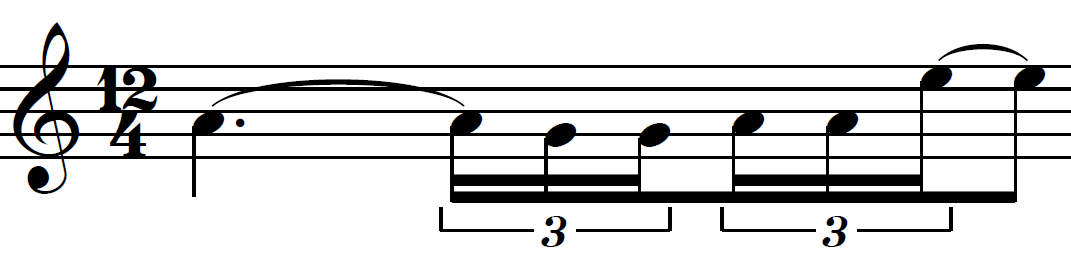
This actually takes place in 12/8, not 4/4, but is traditionally
notated in 4/4 as the gracenote timings are never written down. 2 Think of the crunluath having 'active' and 'passive' elements. 'Active' means the things we would write down by ear - the Low Gs and low As in the embellishment. Passive are the cutting notes, which have definite pitch but are so short a normal person wouldn't be able to write them down from hearing. The effect of the active elements is that they seem to all be of the same length. The passive ones should be small enough to not interfere with the rippling effect. The desired rhythmical effect is illustrated below. 3 Please note that in effect, the destination E in a crunluath is syncopated. 4 Listen carefully with this information in mind and you will be able to hear the rhythm coming across in the lows G and low As 5 As with other variations, you should slow down at the end of this variation, more than the other variations as this is showing the end of the variations and return to the ground. This is a matter of musical semiotics. |
'Active' elements...
It is conventional to repeat the Ground for piobaireachd after you have played all the variations. For longer pieces in public performance, the piper often only repeats the first line. For small pieces like this and for private satisfaction, repeating the whole Ground is a good idea.
It is common to add a crunuath a mach variation in this tune, and especially effective for concert perfoemance.
Once you have thought about all of these things, you can sing and play along with the videos below. These videos are made from the notation and are played by the computer as a demonstration that this approach is possible and actually works.
The Gordon's Salute from midi - whole tune low pitch
The Gordon's Salute from midi - whole tune high pitch
howtodothings.com
Site map and contents
Youtube Channel
Clan Davidson Virtual Pipe Band
GHB Exercises
SSP Library
SSP Exercises
Medieval Music Library